Biohazard cleanup (also called biohazard remediation, trauma cleaning, or crime scene cleanup) is the professional process of safely removing, decontaminating, and disposing of biological hazards — including blood, bodily fluids, human tissue, decomposition materials, and other potentially infectious substances — from a residential or commercial property. It requires OSHA-certified technicians, EPA-approved disinfectants, full personal protective equipment (PPE), and compliance with federal, state, and local regulations for biohazardous waste disposal.
What Is Biohazard Cleanup?
When a traumatic event occurs — a violent crime, an unattended death, a serious accident — emergency responders like police and paramedics handle the medical and legal aspects. But once they leave, the physical scene remains contaminated. That's where biohazard cleanup professionals step in.
Biohazard cleanup companies are specialized remediation firms trained to safely and thoroughly clean properties affected by biological contamination. Unlike standard janitorial services, biohazard technicians are:
- Trained under OSHA's Bloodborne Pathogen Standard (29 CFR 1910.1030)
- Equipped with proper PPE including Tyvek suits, respirators, and chemical-resistant gloves
- Licensed to handle and transport biohazardous medical waste
- Certified to use EPA-registered hospital-grade disinfectants
- Experienced in structural assessment and restoration coordination
Biohazard cleanup is required whenever biological materials — blood, bodily fluids, decomposing tissue, or infectious waste — contaminate a space. It is always safer and legally more appropriate to hire certified professionals than to attempt cleanup yourself. In Fort Worth, TX, call +1 (817) 547-0217 for immediate 24/7 response.
Why Is Biohazard Cleanup Important?
Biohazard cleanup is important for three critical reasons: public health and safety, legal compliance, and psychological well-being.
1. Serious Health Risks from Blood-Borne Pathogens
Biological materials can contain deadly pathogens that survive far longer on surfaces than most people realize. Without professional-grade disinfection, anyone who enters a contaminated area risks exposure to:
| Pathogen | Survival on Surfaces | Risk Level | Transmission Route |
|---|---|---|---|
| Hepatitis B (HBV) | Up to 7 days | Very High | Contact with contaminated blood/fluids |
| Hepatitis C (HCV) | Up to 4 days | High | Blood-to-blood contact |
| HIV | Up to 4 days (in dried blood) | Moderate-High | Contact with infected blood/fluids |
| MRSA | Days to weeks | High | Skin contact, respiratory |
| C. difficile (C. diff) | Months (spores) | Very High | Ingestion of spores |
Critical Warning: Household bleach and standard cleaning products do not kill blood-borne pathogens at safe concentration levels. Only EPA-registered disinfectants with specific kill claims for blood-borne pathogens provide adequate protection. Using consumer products on a biohazardous scene creates a false sense of security and leaves dangerous contamination behind.
2. Legal Requirements for Biohazardous Waste Disposal
In Texas, the disposal of biohazardous waste is strictly regulated by the Texas Commission on Environmental Quality (TCEQ) and the Texas Health and Safety Code, Chapter 361. Biohazardous waste — including blood-soaked materials, contaminated PPE, and biological waste — cannot be placed in standard trash. It must be:
- Placed in DOT-approved, properly labeled red biohazard bags and rigid containers
- Transported by a licensed medical waste hauler
- Treated at a licensed medical waste treatment facility (typically incineration)
- Tracked with a manifest from point of collection to final disposal
Improper disposal of biohazardous waste in Texas can result in fines up to $25,000 per day, per violation under Texas Health and Safety Code Section 361.252. Property owners who attempt DIY cleanup and dispose of contaminated materials improperly may face significant legal liability.
3. Psychological Impact on Affected Families
Beyond the physical dangers, biohazard events leave lasting psychological trauma. Professional cleanup companies understand this. They work with discretion, compassion, and efficiency — minimizing the time families must be exposed to the physical reminders of a traumatic event. Many certified cleanup companies in Fort Worth also coordinate directly with insurance companies and victim's assistance programs so families can focus on healing.
Types of Situations That Require Biohazard Cleanup
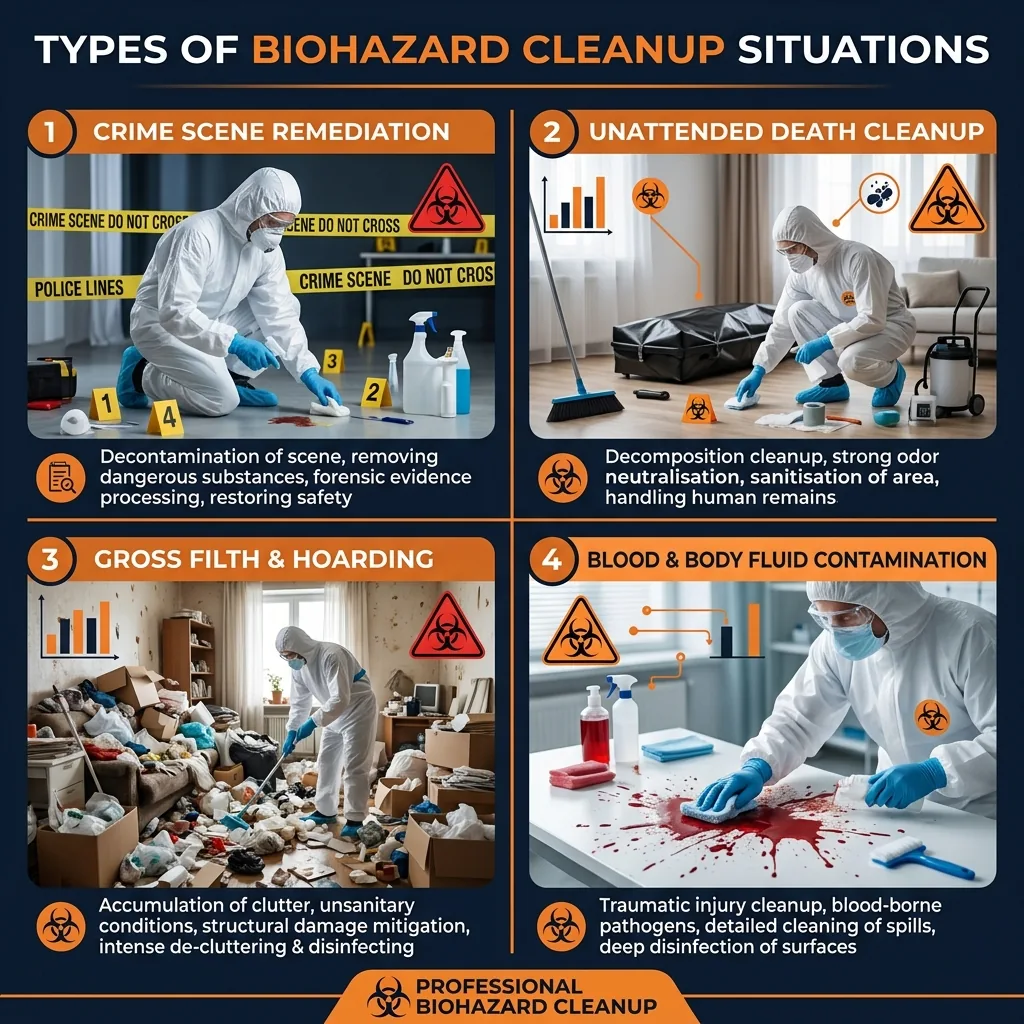
Not every biohazard situation looks the same. Here are the most common scenarios that require professional biohazard remediation:
Crime Scene Cleanup
Homicide, assault, or violent crime scenes involving blood, tissue, and biological material require professional remediation after law enforcement releases the scene.
Unattended Death
When a person passes away and is not discovered for days or weeks, decomposition creates complex biohazards requiring specialized removal and decontamination.
Blood & Bodily Fluid Cleanup
Traumatic accidents, medical emergencies, or injuries can result in significant blood contamination that requires professional handling to eliminate pathogen risks.
Hoarding Cleanup
Severe hoarding situations often involve human or animal waste, rotting food, mold, and other biohazards that require professional assessment and remediation.
Drug Lab Decontamination
Methamphetamine labs and other illicit drug manufacturing sites create severe chemical and biological contamination that is hazardous to anyone entering the space.
Sewage & Waste Backups
Raw sewage contains Category 3 (black water) contamination carrying dangerous bacteria, viruses, and parasites that require professional biohazard cleaning.
DIY vs. Professional Biohazard Cleanup: A Comparison
| Factor | DIY Cleanup | Professional Cleanup |
|---|---|---|
| Pathogen elimination | ❌ Incomplete | ✅ Guaranteed |
| OSHA compliance | ❌ Not possible | ✅ Fully compliant |
| Waste disposal legality | ❌ Illegal (Texas law) | ✅ Legally compliant |
| Personal safety | ❌ High exposure risk | ✅ Full PPE protection |
| Hidden contamination | ❌ Often missed | ✅ Comprehensive testing |
| Insurance coordination | ⚠️ Difficult | ✅ Direct billing available |
| Odor elimination | ❌ Typically fails | ✅ Industrial-grade treatment |
| Documentation & clearance certificate | ❌ None available | ✅ Written certification provided |
The Professional Biohazard Cleanup Process: Step by Step
Understanding what professional biohazard cleanup involves can help property owners feel more prepared during an already stressful time. Here is the standard process used by certified technicians in Fort Worth, TX:
Initial Assessment & Scene Evaluation
Certified technicians arrive in full PPE and conduct a thorough assessment of the contamination scope. They identify all affected surfaces including porous materials (carpet, drywall, subflooring) that may require removal, and develop a remediation protocol. A scope of work is established and documented for insurance purposes.
Typically 30–60 minutesSite Containment & Worker Protection
Plastic sheeting (6-mil polyethylene) is installed to create containment zones, preventing cross-contamination of unaffected areas. HEPA-filtered negative air pressure machines create a directional airflow that captures airborne particulates and prevents biohazard materials from spreading. All technicians don appropriate PPE for the specific hazard level.
OSHA RequiredBiohazardous Material Removal
All visible biological materials are carefully collected using appropriate tools and placed in properly labeled DOT-approved biohazard containers. Saturated porous materials — including carpet, padding, drywall, and subflooring — that cannot be adequately decontaminated are removed and bagged for disposal. This step must be thorough to prevent ongoing odor issues and contamination.
DOT Compliant DisposalDeep Cleaning & Decontamination
All surfaces are treated with EPA-registered, hospital-grade disinfectants specifically tested and proven effective against HIV, Hepatitis B, Hepatitis C, MRSA, and other blood-borne pathogens. Disinfectants are applied at appropriate concentrations and allowed adequate dwell time to achieve full kill rates. This step may include multiple applications for heavily contaminated surfaces.
EPA Registered DisinfectantsOdor Treatment & Air Purification
Biological decomposition creates complex odor compounds that penetrate porous surfaces and persist long after visible materials are removed. Technicians use specialized enzymatic odor digesters, hydroxyl generators, ozone treatment (where appropriate), and thermal fogging to neutralize odor molecules at their source. HEPA air scrubbers with activated carbon filters run throughout and after the cleaning process.
Industrial-Grade TreatmentPost-Cleanup Verification & Clearance Certificate
Upon completion, technicians conduct a final inspection and, when appropriate, ATP (adenosine triphosphate) testing or other verification methods to confirm elimination of biological contamination. A written clearance certificate is provided documenting that the remediation was completed according to applicable standards. This documentation is essential for insurance claims and property transactions.
Written Clearance ProvidedHow Much Does Biohazard Cleanup Cost in Fort Worth, TX?
Biohazard cleanup costs vary significantly based on the type and severity of the incident, the size of the affected area, and the amount of structural remediation required. Here is a general cost guide for Fort Worth, TX:
| Type of Cleanup | Typical Cost Range | Factors Affecting Cost |
|---|---|---|
| Minor blood/fluid cleanup | $500 – $1,500 | Area size, surface type, contamination level |
| Crime scene cleanup | $1,500 – $5,000 | Incident type, affected area, structural damage |
| Unattended death (recent) | $3,000 – $6,000 | Time elapsed, area size, structural penetration |
| Unattended death (advanced decomposition) | $5,000 – $25,000+ | Decomposition stage, structural remediation needed |
| Hoarding cleanup | $1,000 – $15,000+ | Volume of materials, biohazard presence, property size |
| Meth lab decontamination | $3,000 – $30,000 | Testing requirements, structural decontamination, Texas DSHS protocol |
Good news: Most homeowner's insurance policies and renter's insurance policies cover biohazard cleanup costs. We work directly with your insurer, handle all documentation, and can often bill insurance directly so you pay little to nothing out of pocket. Texas Crime Victims' Compensation may also cover costs for crime-related incidents. Contact us for a free estimate.
What Certifications Should a Biohazard Cleanup Company Have?
When hiring a biohazard cleanup company in Fort Worth or anywhere in DFW, always verify these credentials:
Biohazard Cleanup in Fort Worth, TX: What Makes It Different
Fort Worth, TX and the broader DFW Metroplex has specific regulations and resources that affect biohazard cleanup services:
- Texas DSHS Oversight: Biohazardous waste contractors in Texas must be licensed by the Texas Department of State Health Services and comply with Texas Health and Safety Code Chapter 361.
- TCEQ Environmental Compliance: All biohazardous waste disposal must comply with Texas Commission on Environmental Quality regulations.
- Crime Victims' Compensation: Texas residents who are victims of violent crimes may be eligible for assistance through the Texas Attorney General's Crime Victims' Compensation program, which can cover biohazard cleanup costs.
- Tarrant County Resources: Fort Worth is in Tarrant County, which has specific protocols for coordinating with the Tarrant County Medical Examiner's Office in cases involving unattended deaths.
- DFW Response Times: Our Fort Worth team can typically respond within 1-2 hours to most DFW locations including Arlington, Keller, Southlake, Grapevine, and North Richland Hills.
Our Fort Worth biohazard cleanup team serves the entire DFW Metroplex, including Arlington, Dallas, Keller, Southlake, Grapevine, Burleson, Benbrook, Weatherford, and North Richland Hills. We dispatch immediately upon your call — 24 hours a day, 365 days a year.
Frequently Asked Questions
Everything you need to know about biohazard cleanup in Fort Worth, TX
Regular cleaning removes visible dirt, dust, and everyday grime using household cleaners. Biohazard cleanup is a specialized service that goes far beyond this — it requires OSHA-certified technicians, EPA-registered hospital-grade disinfectants proven effective against blood-borne pathogens, full personal protective equipment, and legally compliant disposal of biohazardous materials. Biohazard cleanup also involves testing and documentation that regular cleaning services cannot provide.
Blood and bodily fluids can contain lethal blood-borne pathogens including HIV, Hepatitis B, and Hepatitis C. Hepatitis B can survive on dry surfaces for up to 7 days. Without proper PPE, training, and EPA-approved disinfectants, you risk serious infection. Additionally, Texas law prohibits the disposal of biohazardous waste in standard trash — doing so can result in fines up to $25,000 per day. Consumer cleaning products are not effective at pathogen elimination on contaminated surfaces.
Our Fort Worth team is available 24 hours a day, 7 days a week, 365 days a year. We dispatch immediately upon receiving your call. For most Fort Worth and DFW locations, we can typically arrive within 1-2 hours. Faster response means less time for contamination to spread, reduced odor development, and a quicker return to a safe living or working environment.
In most cases, yes. Standard homeowner's insurance (HO-3 and HO-5 policies) and renter's insurance typically cover biohazard cleanup as part of covered events. Coverage depends on your specific policy and the nature of the incident. We work directly with your insurance company, provide all required documentation, and can often bill insurance directly. Texas Crime Victims' Compensation may also cover costs for crime-related incidents. We provide free consultations and estimates.
Yes. Reputable biohazard cleanup companies understand the sensitive nature of these situations. Our team arrives in unmarked vehicles when requested, works without drawing unnecessary attention, and maintains strict confidentiality. We treat every situation with professionalism, compassion, and respect for the privacy of those involved. Our goal is to restore your space quickly and allow you to focus on healing.
We serve all of Fort Worth, TX and the surrounding DFW Metroplex including Arlington, Dallas, Keller, Southlake, Grapevine, North Richland Hills, Burleson, Benbrook, Weatherford, Mansfield, Hurst, Euless, Bedford, Colleyville, and all communities in Tarrant County and Denton County. For areas outside DFW, contact us to confirm availability.