Unattended death cleanup (also called undiscovered death cleanup, decomposition cleanup, or post-mortem cleanup) is the professional remediation of a property where a person passed away and was not discovered for an extended period — hours, days, weeks, or longer. Unlike an attended death, unattended deaths involve biological decomposition that creates serious biohazard contamination requiring OSHA-certified professionals, EPA-registered disinfectants, and licensed biohazardous waste disposal under Texas and federal law.
What Is Unattended Death Cleanup?
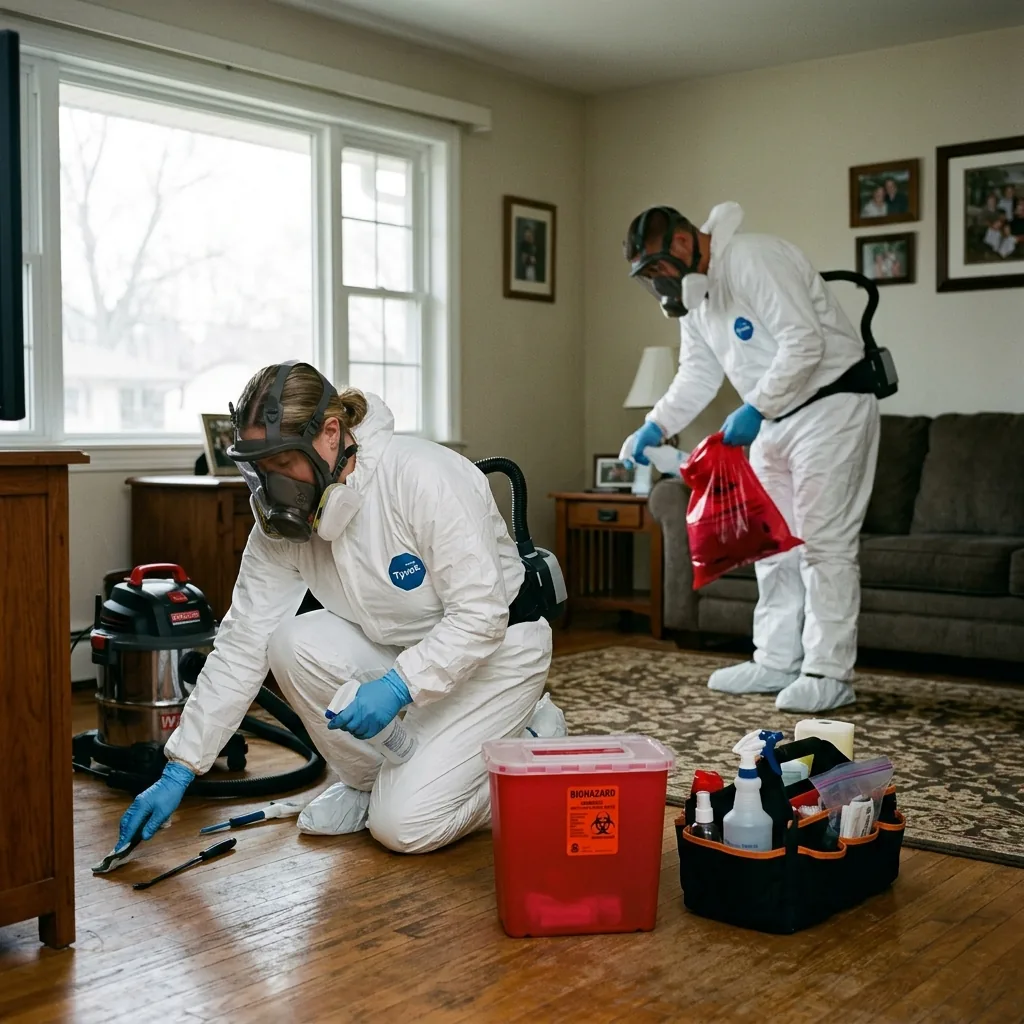
When a person passes away and is not discovered immediately, the human body begins a natural decomposition process that rapidly creates serious biological hazards in the surrounding environment. This is one of the most complex and emotionally difficult cleanup situations that families ever face.
Professional unattended death cleanup involves the complete remediation of all biological contamination — not just what is visible, but contamination that has penetrated porous materials including carpet, padding, subflooring, concrete, drywall, furniture, and even structural members beneath the surface.
If you've discovered an unattended death in Fort Worth, TX: 1) Call 911 immediately if you're not sure the person is deceased. 2) Do not enter the room or disturb anything. 3) Wait for FWPD and the Tarrant County Medical Examiner. 4) Once the ME releases the scene in writing, call our certified team at +1 (817) 547-0217 immediately — available 24/7.
Your Immediate First Steps
Discovering an unattended death is traumatic. Here is a clear, step-by-step guide to what you must do — and in what order:
Fort Worth Summer Warning: Temperatures exceeding 100°F dramatically accelerate decomposition. In an enclosed, unventilated space, biological materials can reach critical hazard levels within 24–48 hours. Decomposition gases (including hydrogen sulfide and methane) can accumulate to dangerous concentrations in sealed rooms. Never enter a room where an unattended death has occurred without professional assessment first.
Why Unattended Death Cleanup Requires Certified Professionals
Unattended death scenes present a combination of biological, chemical, and structural hazards that go far beyond what any standard cleaning service can handle safely or legally:
| Biohazard | Source | Risk Level | Why Standard Cleaners Fail |
|---|---|---|---|
| Hepatitis B (HBV) | Blood, bodily fluids | Very High | Survives 7+ days; consumer bleach ineffective at safe concentrations |
| Hepatitis C (HCV) | Blood | High | Survives 4 days on surfaces; penetrates porous materials |
| HIV | Blood, bodily fluids | Moderate-High | Survives 4 days in dried blood; invisible to naked eye |
| Clostridium difficile | Digestive tract release | Very High | Spores survive months; resistant to most disinfectants |
| Decomposition gases | Bacterial breakdown | Acute | H₂S and methane accumulate; respiratory emergency risk |
| Mold | Moisture + biological material | High | Penetrates walls and subfloor; spreads if disturbed without containment |
The Professional 6-Step Unattended Death Cleanup Process
Every cleanup performed by our OSHA-certified Fort Worth team follows this standardized protocol:
Scene Release & Initial Assessment
After receiving the Tarrant County ME's written scene release, our team arrives in full PPE. We conduct a thorough contamination assessment: decomposition stage, affected area extent, porous material penetration depth, and structural assessment. Full scope-of-work documentation begins immediately for insurance and estate purposes.
30–60 minutesPPE, Containment & Negative Air Pressure
All technicians don full Tyvek suits, P100 respirators (for decomposition gas protection), double nitrile gloves, and face shields. 6-mil polyethylene containment barriers seal off the work area. HEPA-filtered negative air pressure machines prevent cross-contamination and capture airborne particulates including mold spores and decomposition compounds.
OSHA RequiredBiological Material Removal & Porous Material Extraction
All biological matter is carefully collected and sealed in DOT-approved biohazard containers. Saturated porous materials — carpet, padding, drywall, subflooring, furniture — that cannot be safely decontaminated are removed entirely. This is often the most extensive step in advanced decomposition cases and determines the majority of structural restoration cost.
DOT-Compliant DisposalDeep Cleaning & EPA-Registered Disinfection
All remaining structural surfaces receive multiple applications of EPA-registered hospital-grade disinfectants with proven kill claims against HIV, HBV, HCV, MRSA, and C. difficile. Each application maintains full dwell time — not rushed — to achieve complete pathogen elimination. Concrete slabs may require specialized enzymatic treatment.
EPA-Registered ProductsIndustrial Odor Elimination
Decomposition produces complex odor compounds (putrescine, cadaverine, hydrogen sulfide) that penetrate deeply into structural materials. We use industrial enzymatic deodorizers that destroy these compounds at the molecular level — not masking them. HEPA air scrubbers run continuously. For severe cases, ozone treatment or hydroxyl radical generators are applied after area clearance.
Industrial-Grade TreatmentATP Testing, Final Inspection & Clearance Certificate
Post-cleanup ATP (adenosine triphosphate) bioluminescence testing verifies decontamination on all treated surfaces. A written clearance certificate documents complete remediation to applicable standards — essential for insurance claims, estate settlements, property transactions, and legal proceedings. Full disposal manifests are provided.
Written Clearance ProvidedUnattended Death Cleanup Costs in Fort Worth, TX (2025)
Cost depends primarily on how long the person was undiscovered, the size of the affected area, and the degree of porous material penetration. Fort Worth's heat significantly accelerates decomposition, often increasing costs for delayed discoveries.
| Scenario | Typical Cost Range | Key Factors |
|---|---|---|
| Discovered within 24–48 hours (minimal decomposition) | $1,500 – $3,500 | Limited porous material penetration |
| Discovered after 3–7 days | $3,000 – $8,000 | Carpet/padding removal likely required |
| Discovered after 1–3 weeks | $6,000 – $18,000 | Subflooring and drywall removal typical |
| Advanced decomposition (1+ month) | $12,000 – $35,000+ | Structural remediation, concrete treatment |
| Summer discovery (Fort Worth heat acceleration) | Add 30–50% above baseline | Heat dramatically accelerates penetration |
Good news: Most homeowner's insurance policies and renter's insurance policies cover unattended death cleanup costs. We work directly with your insurer, handle all documentation, and can often bill insurance directly so you pay little to nothing out of pocket. Texas Crime Victims' Compensation may also assist if the death involved a crime. Contact us for a free estimate.
Insurance & Financial Assistance in Texas
Homeowner's Insurance (HO-3/HO-5)
Standard policies typically cover unattended death cleanup when the death is an accidental or sudden event. We provide all required documentation: itemized invoice, scope of work, photos, and disposal manifests. We communicate directly with your adjuster.
Landlord / Property Insurance
Commercial landlord policies generally cover death scene cleanup on rental properties. Texas law requires landlords to remediate contaminated rental units before re-renting. We work with property managers throughout DFW on landlord insurance claims.
Texas Crime Victims' Compensation
If the death involved a violent crime, the Texas AG's CVC program provides up to $50,000 for qualifying expenses including cleanup. We prepare all required documentation. Apply at texasattorneygeneral.gov within 3 years of the incident.
Estate & Probate Coverage
Cleanup costs are a legitimate estate expense payable before assets are distributed to heirs under Texas Estates Code. Estate executors can authorize cleanup immediately. We provide estate-appropriate invoicing and documentation.
Tarrant County & Fort Worth Specific Resources
Fort Worth and Tarrant County have specific agencies and processes that affect unattended death cleanup:
- Tarrant County Medical Examiner's Office: (817) 920-5700 — Handles all unattended, accidental, and suspicious deaths in Tarrant County. Provides written scene release required before cleanup begins.
- Fort Worth Police Department Non-Emergency: (817) 392-4222 — For non-emergency scene status inquiries.
- Tarrant County Adult Protective Services: (817) 258-8400 — If the deceased was a vulnerable adult, APS may be involved in the investigation and can provide case coordination resources.
- JPS Health Network Grief Support: (817) 702-5800 — Fort Worth's public hospital system provides grief counseling referrals for families of sudden death victims.
- Texas Funeral Services Commission: (512) 936-2474 — For questions about remains transport and funeral arrangements.
Our Fort Worth team serves all Tarrant County communities including Arlington, Keller, Mansfield, North Richland Hills, Hurst, Euless, Bedford, Burleson, Benbrook, and Weatherford. We dispatch immediately upon scene release — 24 hours a day, 365 days a year. Response time: typically 1–2 hours from your call.
Frequently Asked Questions
Unattended death cleanup questions answered by Fort Worth OSHA-certified professionals
Unattended death cleanup is the professional remediation of a space where a person passed away and was not discovered for an extended time. The decomposition process creates biological hazards — blood, bodily fluids, decomposition byproducts — that contaminate surfaces and porous materials. Certified technicians use OSHA-required PPE, EPA-registered disinfectants, and licensed biohazardous waste disposal to fully restore the property to a safe, habitable condition.
Texas law enforcement and the Tarrant County Medical Examiner process the scene and remove the remains, but they do not clean the property. Cleanup responsibility falls on the property owner, estate executor, or landlord. No Texas government agency provides free death scene cleanup for private properties. This is why having adequate homeowner's or renter's insurance is critical.
Timeline depends on the decomposition stage, affected area size, and degree of structural penetration. Recently discovered deaths typically take 4–8 hours. Deaths discovered after several days may take 1–2 days. Advanced decomposition cases with structural remediation requirements can take 3–7 days or more. We provide a realistic timeline estimate during our free initial assessment.
In most cases, yes. Standard homeowner's insurance (HO-3 and HO-5 policies) and renter's insurance typically cover unattended death cleanup as a sudden and accidental event. Coverage depends on your specific policy and the nature of the incident. We work directly with your insurance company, provide all required documentation, and can often bill insurance directly. Contact us for a free estimate and insurance eligibility review.
Texas has specific disclosure requirements for property sellers. Under Texas Property Code, sellers must disclose known deaths on the property to potential buyers. For rental properties, landlords must remediate the unit to habitable condition before re-renting. A written clearance certificate from a certified biohazard cleanup company, supported by ATP testing results, is the standard documentation used to demonstrate that full professional remediation has been completed — protecting both the property owner and future occupants.
Yes. We understand the deeply sensitive nature of unattended death situations. We arrive in unmarked vehicles when requested, work without drawing unnecessary attention, and maintain strict confidentiality about all aspects of the situation. Our team treats every family with compassion, professionalism, and complete discretion. Your privacy is our priority from the first phone call through final clearance.