Hoarding disorder is not laziness, weakness, or a lifestyle choice. It is a recognized mental health condition (DSM-5 F42.3) with neurological underpinnings, distinct from normal collecting behavior, and requiring professional mental health treatment. Approaching a loved one with understanding rather than judgment is the single most important factor in successful outcomes.
01What Is Hoarding Disorder?
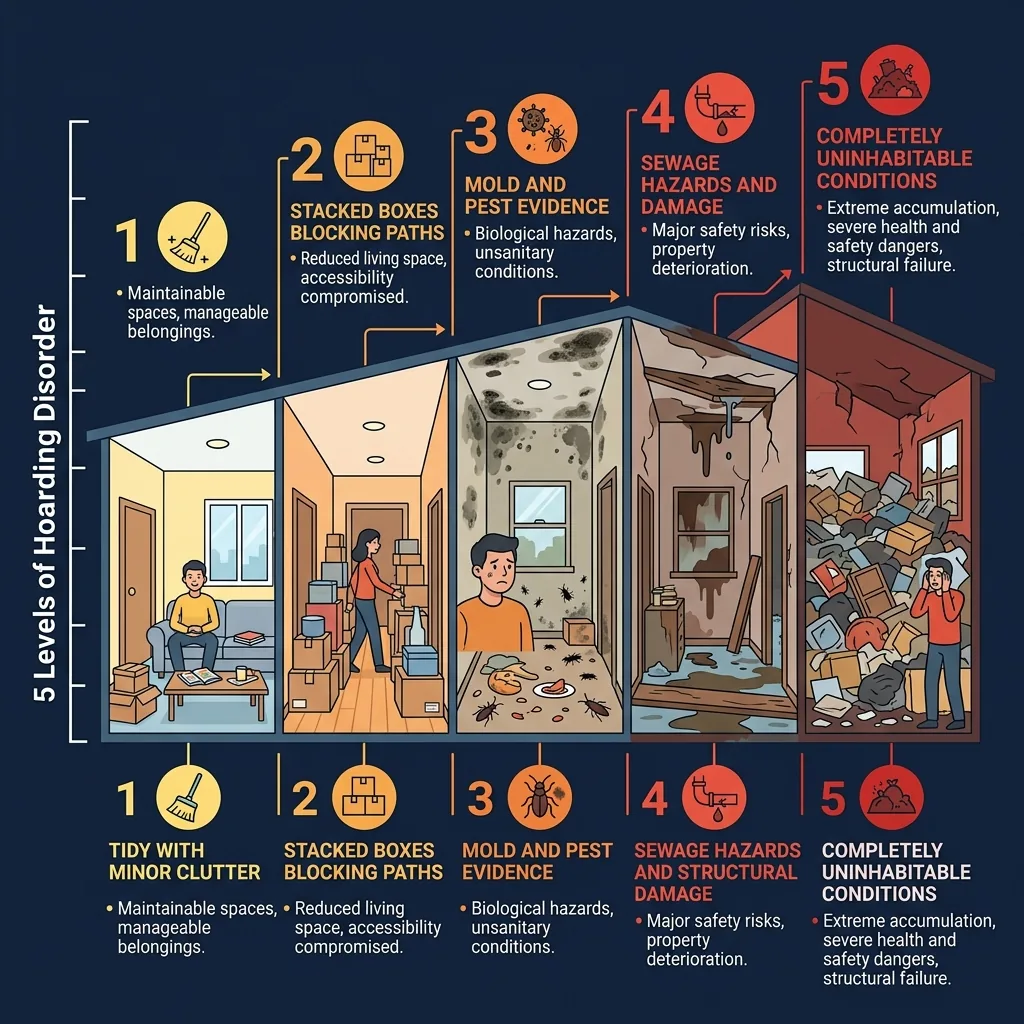
Hoarding disorder is a persistent mental health condition characterized by difficulty discarding or parting with possessions, regardless of their actual value, due to a perceived need to save items and significant distress associated with discarding them. The resulting accumulation of possessions clutters living spaces and substantially compromises their intended use.
Research published in the American Journal of Psychiatry estimates hoarding disorder affects 2–6% of the general population — approximately 6–19 million Americans. In the Fort Worth / DFW metro area of approximately 7.8 million people, that represents an estimated 156,000–468,000 individuals living with hoarding disorder to some degree.
02DSM-5 Clinical Criteria for Hoarding Disorder
The American Psychiatric Association's DSM-5 (Diagnostic and Statistical Manual of Mental Disorders, 5th edition) lists five criteria that must all be present for a clinical diagnosis of hoarding disorder (F42.3):
Criterion A: Persistent Difficulty Discarding
Persistent difficulty discarding or parting with possessions, regardless of their actual value. The difficulty is due to perceived need to save items and distress associated with discarding them. This is not about money — individuals with hoarding disorder struggle equally to discard worthless items.
Criterion B: Perceived Need to Save
The difficulty discarding possessions is due to a perceived need to save items and to distress associated with discarding them. Common saving rationales include: sentimental value, potential future utility, aesthetic appeal, or fear of losing important information. The perceived need is real to the individual.
Criterion C: Cluttered Living Spaces
The accumulation of possessions that congest and clutter active living areas and substantially compromises their intended use. If living spaces are uncluttered, it is only because of the interventions of third parties (family members, cleaning services, authorities). Storage areas that are cluttered but not living spaces may not meet this criterion.
Criterion D: Clinically Significant Distress
The hoarding causes clinically significant distress or impairment in social, occupational, or other important areas of functioning (including maintaining a safe environment for self and others). This criterion distinguishes clinical hoarding disorder from simple collecting habits.
Criterion E: Not Due to Another Condition
The hoarding is not attributable to another medical condition (brain injury, Prader-Willi syndrome) and is not better explained by another mental disorder (OCD obsessions, major depressive disorder, autism spectrum disorder, psychotic disorder). A qualified mental health professional makes this determination through clinical assessment.
03Clutter vs. Hoarding Disorder: Key Differences
| Factor | Normal Clutter | Hoarding Disorder |
|---|---|---|
| Discarding difficulty | Temporary; person can eventually discard with motivation | Persistent; causes significant distress or anxiety even when person wants to discard |
| Living space impact | Messy but rooms usable for intended purpose | Primary living spaces (kitchen, bedroom, bathroom) compromised or unusable |
| Awareness | Person aware accumulation is a problem | May have poor insight into severity; often does not see it as others do |
| Emotional response to discarding | Mild; can discard without significant distress | Severe anxiety, grief, or panic when discarding or discussing discarding |
| Social impact | Mild embarrassment; does not prevent social engagement | Social isolation; refuses visitors; relationships severely impacted |
| Safety impact | No significant safety hazards created | May create fire hazards, fall risks, pest infestation, mold, structural compromise |
04How to Approach a Loved One with Hoarding Disorder
The most common mistake: Cleaning or discarding items without the person's knowledge or consent. This approach almost universally backfires, causing severe emotional trauma, destroying trust, and making future intervention more difficult. Even when done with good intentions, it is counterproductive.
Lead with Concern, Not Criticism
Begin from a place of genuine concern for the person's wellbeing, safety, and happiness — not from judgment about the condition of their home. "I love you and I'm worried about your safety" opens doors that "your house is a disaster" permanently closes. The accumulation reflects genuine psychological distress, not moral failure.
Use Motivational Interviewing Principles
Ask questions about what the person values and wants for their life. "What would you do differently if you had more space?" "Is there anything about the current situation that bothers you?" Motivational interviewing helps the person identify their own reasons to change — far more powerful than external pressure.
Encourage Professional Assessment First
Before any cleanup, encourage a clinical assessment by a licensed therapist specializing in hoarding disorder or OCD. The International OCD Foundation (IOCDF) maintains a therapist directory at iocdf.org. Tarrant County Mental Health (MHMR) provides sliding-scale assessments. A therapist can guide the intervention in a clinically appropriate way.
Involve the Person in Every Decision
If and when cleanup proceeds, involve the person in all decisions. Sort items into "keep," "maybe," and "discard" categories together. Respect their decisions even when you disagree. The goal is sustainable progress with trust intact, not rapid cleanup that leads to re-accumulation within months.
Set Safety-Based, Non-Negotiable Boundaries
Some boundaries are non-negotiable for safety: blocked fire egress, inability to use kitchen or bathroom, pest infestation that affects others, child or elder safety concerns. Frame these as safety requirements that must be addressed — not preferences. If the person's safety is at immediate risk, contact Tarrant County Adult Protective Services or the Fort Worth Code Compliance Division.
05Evidence-Based Treatment Options
Cognitive Behavioral Therapy (CBT)
CBT is the gold-standard evidence-based treatment for hoarding disorder. Specifically, a protocol developed at Boston University (Steketee & Frost) has shown the strongest outcomes. CBT for hoarding addresses cognitive distortions about objects, decision-making skills, and gradual exposure to discarding. Treatment typically involves 26+ sessions with a hoarding-specialist therapist.
Cognitive Rehabilitation and Exposure (CRE)
CRE targets the executive functioning deficits (categorizing, organizing, deciding) that contribute to hoarding. It combines cognitive rehabilitation techniques with exposure and response prevention. CRE can be delivered individually or in group format and has shown good outcomes even with individuals who have poor insight into their condition.
Medication
SSRIs (serotonin reuptake inhibitors) such as paroxetine, fluoxetine, and fluvoxamine have shown some efficacy for hoarding symptoms, particularly when comorbid depression or OCD is present. Medication alone is generally insufficient — the strongest outcomes come from combining pharmacotherapy with CBT.
Peer Support Groups
The International OCD Foundation's Hoarding Resource Center lists support groups for people with hoarding disorder and their families. Online groups through iocdf.org provide accessible support. The Children of Hoarders (COH) community at childrenofhoarders.com offers support specifically for adult children of parents with hoarding disorder.
06Tarrant County Mental Health Resources
| Resource | Services | Contact |
|---|---|---|
| MHMR Tarrant County | Mental health assessment, therapy, medication management; sliding-scale fees based on income | mhmrtc.org | (817) 335-3022 |
| JPS Health Network | Behavioral health services; psychiatric evaluation; inpatient and outpatient options | jpshealthnet.org | (817) 702-1000 |
| Tarrant County Adult Protective Services | Safety assessment for vulnerable adults in hoarding situations; mandatory reporting | hhs.texas.gov/APS | 1-800-252-5400 |
| Fort Worth Code Compliance | Property safety standards enforcement; can mandate cleanup for safety hazards | fortworthtexas.gov | (817) 392-1234 |
| IOCDF Therapist Finder | Directory of hoarding-specialist therapists nationwide; searchable by location | iocdf.org/find-help |
| Children of Hoarders (COH) | Support community and resources for family members of people with hoarding disorder | childrenofhoarders.com |
07When Professional Biohazard Cleanup Is Required
Hoarding situations that reach ICD Levels 3–5 contain biohazard conditions that cannot be safely addressed by family members or standard cleaning companies. At these levels, OSHA-certified biohazard professionals are required under Texas law:
Our approach to hoarding cleanup: We work collaboratively with families, therapists, and social workers. We never rush, never discard items without documented consent, and never treat any client without dignity and compassion. We understand that hoarding cleanup is not just a cleaning job — it is part of a person's recovery journey. Contact us to discuss your situation in confidence.
Compassionate Hoarding Cleanup — Fort Worth
Trauma-informed approach. Family coordination. No judgment. Confidential consultation available.
Frequently Asked Questions
Hoarding disorder and mental health questions answered compassionately
Hoarding disorder (DSM-5 F42.3) is persistent difficulty discarding possessions regardless of their value, due to perceived need to save them and distress associated with discarding. The accumulation compromises living spaces and causes clinically significant distress or impairment. It affects 2-6% of Americans and requires professional mental health treatment — not just cleanup — for sustainable outcomes.
Lead with compassion, not judgment. Never clean or discard items without explicit consent — this destroys trust and worsens outcomes. Encourage professional mental health evaluation first. Use motivational interviewing: ask what they value and want for their life. If safety concerns exist, contact Tarrant County MHMR or Adult Protective Services for professional guidance. We can also recommend social workers who specialize in hoarding intervention coordination.
Hoarding becomes a biohazard emergency (ICD Levels 3-5) when the property contains: active rodent or insect infestation, animal or human waste accumulation, mold colonization from blocked ventilation, rotting organic material, or structural compromise from accumulated weight. At these levels, OSHA-certified biohazard professionals are legally required in Texas. Call us for a confidential assessment — we work with families and clinicians to coordinate cleanup as part of the overall treatment plan.