In DFW, searching "biohazard cleanup near me" returns dozens of results — many of which are national referral networks, unlicensed operators, or standard cleaning companies that market biohazard services they are not legally qualified to perform. Hiring an unqualified company exposes you to health risks, legal liability for improper waste disposal, and claim denial from your insurance company. This guide gives you the verification tools to protect yourself.
01Why Not All Biohazard Companies Are Equal in DFW
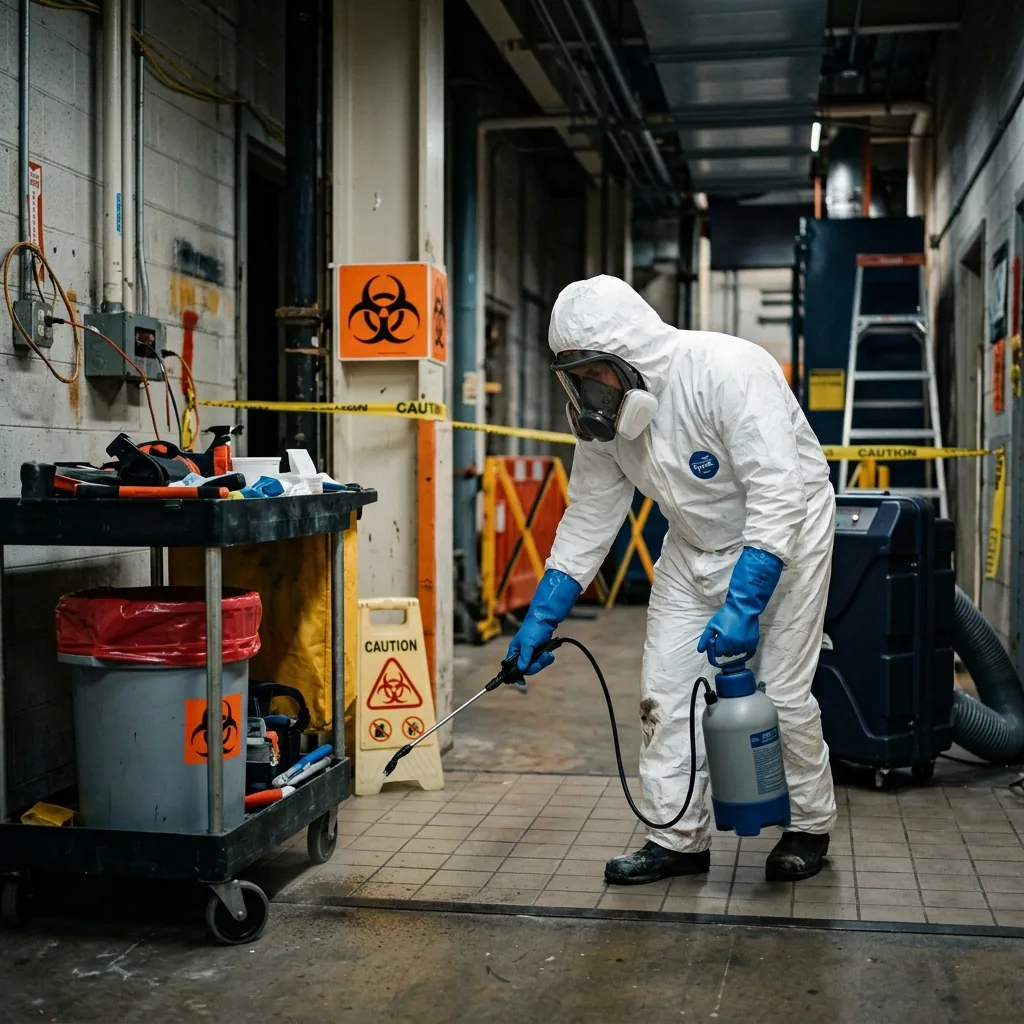
The biohazard cleanup industry has lower barriers to entry than most people expect. There is no single state license that automatically qualifies a company to perform biohazard cleanup in Texas — instead, compliance requires maintaining multiple certifications and licenses simultaneously from different agencies. Companies that lack any one of these are operating illegally:
OSHA 29 CFR 1910.1030 Compliance
Every company performing blood or biological material cleanup must have a written OSHA Blood-Borne Pathogen Exposure Control Plan, annual BBP training records for all workers, documented Hepatitis B vaccination offers, and a post-exposure protocol. Lack of any of these is an OSHA violation.
Texas TCEQ Biohazardous Waste Transport License
All biohazardous waste must be transported by TCEQ-licensed vehicles and drivers. Unlicensed companies either dispose of waste illegally (exposing you to fines) or subcontract to licensed haulers — adding cost without disclosure. Verify the TCEQ license number before work begins.
HAZWOPER 40-Hour Certification
Lead technicians at qualified biohazard companies hold the OSHA HAZWOPER (29 CFR 1910.120) 40-hour certification plus annual 8-hour refresher. This is the industry benchmark for biohazard and hazardous waste operations competency. Ask for the certification card.
ATP Testing Capability
Legitimate companies own or have direct access to ATP bioluminescence meters for post-cleanup verification. Companies without this equipment cannot scientifically verify that decontamination was successful — meaning they cannot issue a genuine clearance certificate.
027-Step Verification Checklist Before Hiring Any DFW Company
Ask for Their TCEQ License Number
Request the company's Texas Commission on Environmental Quality (TCEQ) biohazardous waste transporter license number. You can verify this instantly at tceq.texas.gov → Search "Regulated Entity" → Enter the license number or company name. If they can't provide a number or you can't find it in the database, walk away.
Confirm OSHA BBP Compliance
Ask: "Do you have a written OSHA 1910.1030 Exposure Control Plan?" Any compliant company answers yes immediately and can describe it. Ask for annual training completion dates for the specific technicians who will work your job. Hesitation or vague answers are disqualifying.
Verify HAZWOPER Certification
Ask the lead technician for their HAZWOPER certification card (OSHA 29 CFR 1910.120, 40-hour training). The card shows the training date and renewal date. Certifications more than 12 months old without a documented 8-hour annual refresher are expired under OSHA requirements.
Require a Free On-Site Assessment First
No legitimate biohazard company provides firm pricing over the phone. If any company gives you a fixed price without seeing the scene, that is a red flag. Request a free on-site assessment with a written, itemized estimate before authorizing any work. This should cost you nothing.
Confirm ATP Testing and Written Clearance Certificate
Ask specifically: "Do you perform ATP bioluminescence testing after cleanup and provide a written clearance certificate?" If the company says this is unnecessary or they've never heard of ATP testing, they are not operating at professional standards. This documentation is required for insurance claims and property transactions.
Verify Direct Insurance Billing Capability
Ask: "Do you bill insurance directly?" Legitimate biohazard companies in DFW have established relationships with insurance carriers and handle billing directly. Companies that require full upfront payment and expect you to seek reimbursement are either new to the industry or not trusted by insurers — both are concerning.
Check Google Reviews and BBB — But Critically
Check Google reviews specifically for reviews that mention OSHA compliance, insurance billing, documentation, and professionalism — not just "they cleaned up the mess." Check the Better Business Bureau (bbb.org) for formal complaints. Be skeptical of companies with only 5-star reviews and no reviews mentioning specific technical details.
03Red Flags: Walk Away From Any Company That Does These
These are not minor concerns — they are disqualifying behaviors that indicate an unqualified or unethical company:
04DFW Metro Coverage by Area
| DFW Area | Response Time | Key Cities |
|---|---|---|
| Tarrant County West | 45–90 min | Fort Worth, Benbrook, Westworth Village |
| Tarrant County East | 60–80 min | Arlington, Mansfield, Kennedale |
| Tarrant County North | 60–80 min | Keller, Southlake, Grapevine, Colleyville |
| Mid-Cities | 55–75 min | Hurst, Euless, Bedford, North Richland Hills |
| Dallas County West | 75–100 min | Irving, Grand Prairie, Duncanville |
| Dallas County Central | 90–120 min | Dallas (Oak Cliff, Pleasant Grove, East Dallas) |
| Parker / Johnson County | 90–120 min | Weatherford, Cleburne, Burleson |
05Exact Questions to Ask Any DFW Company
Copy and use these exact questions when calling any biohazard cleanup company in DFW. A fully qualified company answers all of them without hesitation:
06How to Verify Biohazard Company Licenses Online in Texas
TCEQ License Verification
Visit tceq.texas.gov → Regulated Entity Search → Search by company name or license number. Verify the waste transporter license is current and not suspended. Takes 2 minutes. Do this before authorizing any work.
EPA Disinfectant Verification
Visit cfpub.epa.gov/oppref/list → Select the relevant EPA list (List B for HIV, List Q for COVID + broad spectrum) → Search the product name or EPA registration number the company gives you. If the product isn't on the list, it's not EPA-registered for blood-borne pathogen use.
BBB Complaint Check
Visit bbb.org → Search the company name in Fort Worth or Arlington → Check for formal complaints, responses, and unresolved disputes. Also search for the company name in OSHA's online inspection records at osha.gov/ords/imis.
Texas SOS Business Search
Visit search.sos.state.tx.us to verify the company is a registered Texas business entity in good standing. Sole proprietors operating without registration in Texas may not carry adequate liability insurance for biohazard work.
We verify willingly. Ask us for any of these: our TCEQ license number, HAZWOPER certification dates, OSHA Exposure Control Plan, EPA disinfectant registration number, or our insurance certificate. We provide all documentation transparently before you authorize any work. Call +1 (817) 547-0217 or request credentials online.
OSHA-Certified Biohazard Cleanup — DFW Metro
All credentials available on request. Free on-site assessment. Direct insurance billing. 24/7.
Frequently Asked Questions
Finding certified biohazard cleanup in DFW — answered honestly
Search for OSHA-certified, TCEQ-licensed biohazard companies serving DFW. Use the 7-step checklist: verify TCEQ license at tceq.texas.gov, confirm OSHA Exposure Control Plan, verify HAZWOPER certification, require free on-site assessment before pricing, confirm ATP testing and clearance certificate capability, verify direct insurance billing, and check BBB. Any company that passes all 7 steps is qualified.
The most serious red flags: giving firm prices over the phone without an on-site assessment, inability to provide a TCEQ license number, no written OSHA Exposure Control Plan, saying ATP testing is "unnecessary," adding major charges after starting work that weren't in the estimate, and requiring full upfront payment without direct insurance billing capability. Any of these should disqualify a company from consideration.
National biohazard referral networks (1-800 numbers that connect you to local contractors) have significant problems: they charge referral fees that inflate your cost, they may not thoroughly vet the local contractors they refer, and when problems occur you have two companies to deal with instead of one direct service provider. In DFW, local direct-service providers like us offer faster response, direct accountability, and no referral markup.